
Roy Moffatt's memoirs
of North Laine
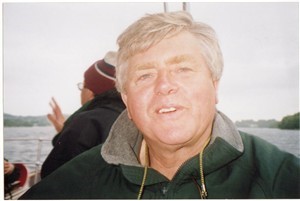
At the end of 2007 Roy Moffatt closed Motorpair's doors in Vine Street for the last time, having traded there for 27 years. Roy didn't originally intend to set up a business in Vine Street, but thanks to him having done so he has much to tell us about the changes over the years in his corner of the North Laine.
Roy qualified as a motor engineer
Growing up around his father's garage in Hove, Roy qualified as a motor engineer. In 1967, at the age of 21, he and Martyn Dearle set up a vehicle repair and servicing business in Shoreham. They called it Motorpair, a pun on the pair of them and the repair of motors. Martyn and Roy had been at school together in the 1950s and in the 60s they were to be seen riding their Lambrettas and Vespas around Brighton in proper mod style.
After a few years Martyn moved off to a variety of other jobs over the next 30 years before returning to Motorpair in Vine Street.
Bidding for a redevelopment site
In 1979 the premises Roy had leased in Shoreham were scheduled for demolition to enable road widening, so he had to relocate fast. He was beginning to get worried when he saw a small advertisement in the back of The Argus. Brighton Council (as it was then) was advertising two sites for bids for redevelopment. One was a tumbledown 19th century workshop in Gloucester Road, the other a derelict site in Vine Street.
Roy thought he could make the Gloucester Road building useable, so he spent time drawing up a carefully worded bid. Then just before the submission date he thought he might as well submit one for the Vine Street site too, although he wasn't so keen on that one. Needless to say his bid for Vine Street was the successful one, probably because he was the only person in 1979 interested in a plot of land with a floor of broken bricks, underneath which lay an air raid shelter!
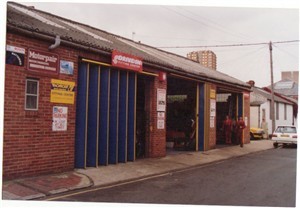
'Motorpair' after an extension in the 1980s
The North Laine wasn't fashionable then
At that
time the property market was very different from today and the North Laine area
wasn't at all fashionable. There were a lot of run-down buildings and a number
of weedy demolition sites used for parking vans. The Argus print works
in Robert Street dominated the area, and their fleet of vans, which raced
around distributing the newspapers, operated from their big workshop in
Gloucester Road, just up from The Eagle pub. There were also a lot of other
small workshops and stores clustered around the area.
A community of small businesses
In those
days no-one lived in Vine Street; it was a community of small businesses. There
were some converted Victorian premises such as obsolete stables, now replaced
by housing, together with the tall warehouse that still remains, although it is
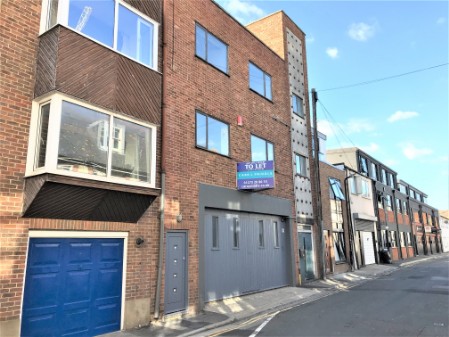
now much smarter than in those days. The maps attached to Roy's title deeds for
numbers 13 and 14 showed that a lot of the original buildings had gone and been
replaced by some pre- or post-war workshops. Clearly his new garage, with its
air-raid shelter, was a World War II creation, as was the block-built
decontamination centre next door where people would have been washed down in
the event of a gas attack. When Roy arrived, this was being used as a print
workshop. Next to that, on the corner of Gloucester Road, was a large
asbestos building which in 1979 was being used for picture framing, although
the maps showed that this had been an army drill hall.
On the
opposite side of the road the tall warehouse was used by a basket-maker and no
doubt this trade accounts for the name of the nearby pub. The packs of
willow wands were soaked in large briny tanks to soften them for forming into
cat baskets, hampers, and furniture. In the winter the off-cuts were used to
heat the building in a big open fire. Further along, where there are now
houses, window frames were manufactured. However, much of that side was
occupied by a long garage where dozens of vans used by Telecom phone engineers
were based. The entrance was onto North Road, where the front part still remains
and is now used by Bill's.
On the
opposite corner with North Road there was the inappropriately named Brick's
glass shop and behind it ran a long workshop with an entrance onto Vine Street,
through which builders went to have glass cut for window panes. The old stables
next to them were used as stores and workshops by small businesses, and
adjoining them the Vokin's Department store (then in North Street) had a
warehouse. Next to Roy's premises was an undertaker's garage, above which they
had a workshop through whose open windows you could hear a cheerful bunch of
carpenters building coffins. If you went up there you could occasionally find a
tired carpenter having a snooze in one of his creations!
Roy's planning application was agreed
So it was
a busy working community that Roy joined. His planning application was agreed.
No one was interested in the street in those days and anyway he was the first
person to build anything new there for years. He needed to start building
quickly, but clearing away the old air raid shelter proved quite a task
because, of course, it was intended to be bomb-proof. He couldn't let the
business he had built up fade away, so he was servicing cars in Shoreham while
starting the ground works on site in Brighton. Only the walls were completed
when he had to vacate Shoreham, so he was obliged to transfer the business to
Vine Street before the roof was on. A helpful Telecom engineer agreed to
install a phone which, for some weeks, used to ring in a plastic bag sheltering
it from the elements!
Fortunately
Ted Spence, who had rented part of Motorpair's space at Shoreham, moved to
Brighton with Roy, and was followed by his many loyal customers. Ted had fought
in both world wars, and had been captured by the Japanese army. He didn't
believe in retirement and stayed at Vine Street for some years, regularly
supplying Roy with fine trout after the fly fishing trips which interspersed
his working days.
The business grew
As the
business grew Roy managed to obtain a two-foot strip of land which made his
yard just large enough to provide two extra parking places. He then extended
his workshop by taking over and demolishing the former decontamination centre
at 16 Vine Street. There was free on-street parking in the early days and a lot
of commuters would leave their cars outside the workshop in the early morning
and pick them up repaired in the evening on their return from work.
For years
Roy tried to persuade the Council to let to him a small open yard opposite the
workshop in order to provide extra off-street parking. Fortunately he succeeded
just before the advent of yellow lines. Alas he had to give up this space a few
years ago when they sold the site for housing. So over the past few years it
was a challenge to ensure that he didn't have more cars than space to park them
in. Most of the time he managed a successful juggle, but there was a crisis if
the AA or RAC arrived with a customer's unexpected breakdown!
Terry joined the firm
Terry,
Roy's older brother, had also worked as a teenager in their father's Hove
garage. He had moved out of the motor trade into the engineering industry, an
occupation which took him as far afield at Saudi Arabia. But contraction of
that sector encouraged him to return to the motor trade in 1994, when he joined
Roy at Motorpair. So for the past decade Roy, Terry and Martin, all now mature,
were working together again in Vine Street. Terry and Roy had both decided that
they would retire in 2008, but before they did so, sadly, Martyn became
ill and died in 2007. And so the closure of Motorpair was brought forward by a
couple of months.
Trade by recommendation
In all
his years in Vine Street Roy never advertised in the newspapers, preferring to
get trade by recommendation. The one exception was the North Laine Runner.
In its early days Roy was asked if he would advertise to help support the new
community paper and his advertisement was in every issue after that. He
built up a lot of regular good customers in the North Laine, and indeed at
times he says it felt as if he was running a village garage. So, unexpectedly,
the North Laine became an important part of Roy's life and he reflects that
moving to Vine Street was not such a bad move after all.
by Sue Moffatt and edited by Francis Clark-Lowes
[Previously
published in the 'North Laine Runner', No 192, May/June 2008]