
William Moon
Inventor of Moon Alphabet
His early life in North Laine
William Moon spent his early working life in and around North Laine and it was here that he established himself as a teacher of the blind and as a publisher of books for the blind in his own script which were sold all over the world. He was a committed Christian who travelled the country preaching to large meetings and also encouraged home learning amongst the blind.
Brought up in Kent
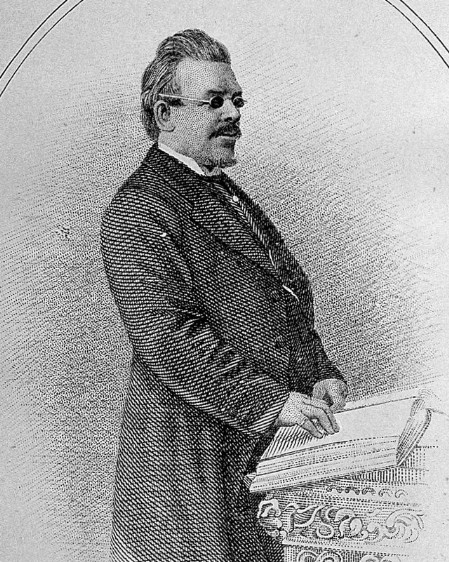
William was born in Horsmonden, near Tunbridge Wells, Kent . He was a healthy young boy until he contracted scarlet fever when he was four which resulted in him losing his sight in one eye. When his widowed mother moved to Brighton, William remained in Hormonsden living with his grandmother. He attended a school in London before joining his mother. He had a strong Christian faith and had hoped to train for the non-conformist ministry but his eye-sight was getting worse and by the time he was twenty one he was totally blind.
Before
he became totally blind, William had learnt the various existing systems for
reading and he used these to teach fellow blind people. He started teaching
blind people at his house and this evolved into a class within the Brighton
Institute for the Deaf and Dumb in Egremeont Place. However, the number of
blind pupils increased so the school moved again and by 1844 was situated in
the Central National Schools in Church Street with the entrance to the Asylum
round the corner in Jubilee Street.
By this time William was married
with a family. At the age of 23, in 1842, he had got married to Mary Ann Caudle and
within three years they had two children, Robert and Adelaide. The family found
life difficult. William found some work teaching the blind and Mary opened an
embroidery business. The family were constantly on the move lived in various
lodging houses in the centre of Brighton.
The Moon Alphabet
Teaching his pupils William soon realized that the existing systems he was using were not always successful. He thought hard about this and devised a simple system of embossed lettering based on the Latin alphabet.
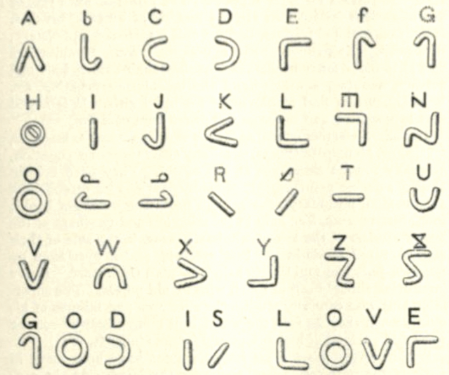
He acquired a wooden printing press and began producing his own books for the blind (mainly on the scriptures). By 1847 he had published his Moon alphabet and soon found a way of producing his books at a low cost. William wanted not just to teach blind people to read using their fingers but he wanted then to be able to read the bible for themselves. His idea was taken up by the British and Foreign Bible Society which distributed his books all over the world.
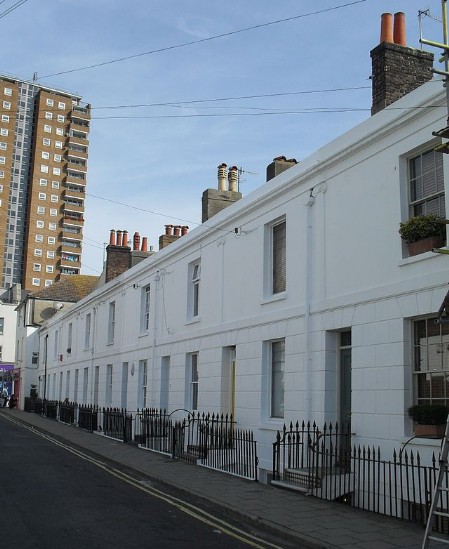
In 1851 William and his family were
able to rent a house in Kensington Place. The 1851 census reports that William,
together with his wife Mary (Caudle) and two children (Robert and Adelaide),
lived at No 44 Kensington Place and that William was Master of the Blind
School. Kelly's Trade Directory for 1846 records that the Blind School was
located in Church Street, although by 1865 it had moved to the premises more
associated with William Moon, 104 Queen's Road, which was to be his office and
home address for many years and in fact continued as a printing works until
1960. In 1858 the complete English Bible was produced in Moon at his printing
works in Queens Road. It had taken ten years to accomplish and consisted of
5,000 pages contained in 60 volumes.
Kensington Place
In
1861 the Blind School moved to newly
constructed premises in Eastern Rd. The opening of the school was featured in
the Illustrated London News on 26 October 1861 and included two school-rooms, a
music and dining hall, work-room and a willow-soaking room for basket-making.
William continued to reside though at 104 Queens Rd and the 1861 census
describes his occupation as Publisher of books for the blind.
Travelling all over the world
By now William was travelling all over the country promoting his system and also preaching the gospel. He had also developed the idea of Home Teaching for the Blind. He advocated groups of interested people forming a committee who would then employ a blind teacher to seek out those who needed help to read Moon, using books from lending libraries. In the early 1850s William had met Sir Charles Lowther who was to become his close friend and supporter. Sir Charles had also been blinded by scarlet fever and was like William a committed Christian. Sir Charles used his wealth to help William realise his dream of enabling the blind to read and also discover the word of God. Robert, his son accompanied his father on many of these tours and on one such trip to Holland the pair took a Moon printing press for the Rotterdam Institute for the Blind. Adelaide also played her part in helping her parents. She remained in Beighton and helped run the printing press which sent books all over the world. By the time he died in 1894 in Brighton, William’s books had been translated into 471 languages and Moon was the standard in many different countries.
During his lifetime William gained many awards. He was elected to fellowships of the Royal Geographical Society and the Royal Society of Arts in 1852 and 1857 respectively. In 1871 he was awarded an honorary LLD degree by the University of Philadelphia.
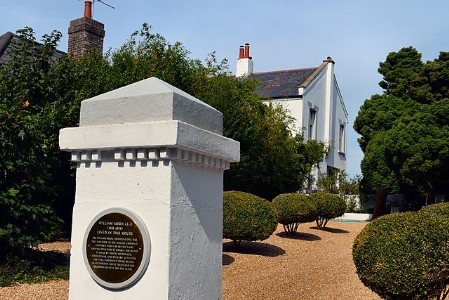
'The Croft' William Moons house in Fulking
Photo credit: Andy Scott
Photo credit: Andy Scott
Later life in Fulking
In later life William bought a house
at Fulking, the Croft, where he would spend summers. And following a stroke in
1892 he spent more and more time in Fulking. He died on 9 October 1894 followed by the dearth of his close
friend Charles Lowther, the following month. His children Adelaide and Robert
continued William’s work by promoting the Moon code and maintaining the use of
the Brighton school.